> ## Documentation Index
> Fetch the complete documentation index at: https://docs.custral.com/llms.txt
> Use this file to discover all available pages before exploring further.
# Record Routing
> Understand how Custral connects Object structure with Record-level navigation.
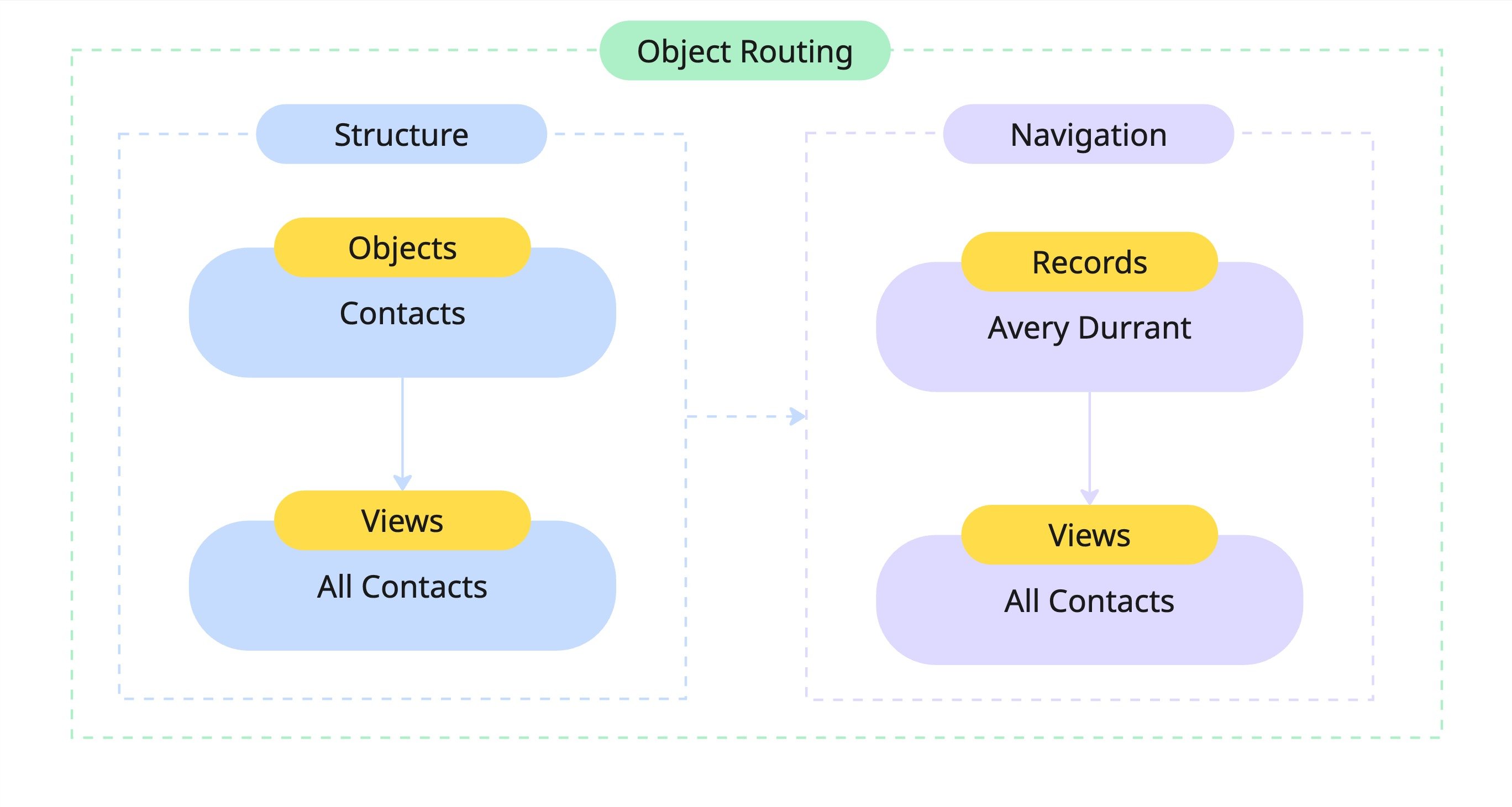
In Custral, **routing** is how you go from a structured data definition to a real, interactive workspace. [Objects](/data/objects/overview) define the structure, which [views](/surfaces/views/overview) and [components](/surfaces/components/overview) exist, while [records](/data/records/overview) bring that structure to life when you open one. Configure a layout once on the object, and every record under it renders that layout, scoped to its own data.
## The two halves
Routing bridges two things:
* **Objects**: where the structure of your data and its views are defined.
* **Records**: where those views are actually displayed and acted on.
When you open a record, Custral loads the record together with its parent object and renders the object's views. Each one scoped to that single record.
 ## How a record opens
Click a row in a database view, a search result, a related-record link on another record, or a link in a workflow or notification. You land at `/records/` (for example, `/records/rec_123`).
The record arrives with its parent object attached, so Custral knows which views to draw and what the record's name and fields are.
Each view configured on the object becomes a tab on the record, scoped to that record's data. No per-record setup required.
## Views come from the object
You lay out a record's experience **once, on its object**, not on each record by hand. Add the views and components you want every record to show (a summary dashboard, lists of related records, an activity feed), and Custral renders that same layout for every record under the object.
| Layer | Role | Example |
| ------------------------------------ | --------------------------------------------------- | --------------------------------------------------------- |
| **[Object](/data/objects/overview)** | Defines the available views and layout. | *Contacts* object → *Overview*, *Related Deals* |
| **[View](/surfaces/views/overview)** | Sets the filters, layout, and components to render. | *Overview* → summary card + activity feed |
| **[Record](/data/records/overview)** | Renders the object's views, scoped to itself. | *Avery Durrant* → the same tabs, filled with Avery's data |
Components adapt to the open record automatically: a "Related Deals" component on the Contacts object shows the deals tied to whichever contact you opened. See [Object Views](/surfaces/records/views) for how this is configured.
## On a record page
A record opens as a full screen with its name and breadcrumb in the header, the object's views as tabs, and a set of actions:
| Action | What it does |
| ------------------------------------ | ---------------------------------------------------------------------- |
| **Share** | Grant another person or group access to this record. |
| **Duplicate** | Create a copy of the record. |
| **Run AI Enrichment** | Run the object's AI auto-fill agents to populate empty properties. |
| **Create Shortcut** | Add a sidebar shortcut, in a section you pick, that opens this record. |
| **Add to Favorites** | Star the record for one-click access from Favorites. |
| **Edit Object / Properties / Views** | Jump to the object to change its structure or record layout. |
| **Delete** | Archive the record. |
## Why this model works
* **Reusability**: define structure once on the object; every record shares a consistent experience.
* **Context**: each record automatically fills the object's views with its own data.
* **Dynamic routing**: every record URL (`/records/`) renders the object's layout without a hand-built page.
* **Linkable**: point dashboards, workflows, and notifications straight at a record; Custral supplies the context.
## Related
How the views you configure on an object appear on every record.
The view types a record's tabs can be built from.
Where a record's structure and views are defined.
The data model behind every record.
## Related topics
- [Object Views](/surfaces/records/views.md)
- [Navigation Overview](/surfaces/navigation/overview.md)
- [Surfaces](/surfaces/overview.md)
- [Chat Routing](/comms/chat/routing.md)
## How a record opens
Click a row in a database view, a search result, a related-record link on another record, or a link in a workflow or notification. You land at `/records/` (for example, `/records/rec_123`).
The record arrives with its parent object attached, so Custral knows which views to draw and what the record's name and fields are.
Each view configured on the object becomes a tab on the record, scoped to that record's data. No per-record setup required.
## Views come from the object
You lay out a record's experience **once, on its object**, not on each record by hand. Add the views and components you want every record to show (a summary dashboard, lists of related records, an activity feed), and Custral renders that same layout for every record under the object.
| Layer | Role | Example |
| ------------------------------------ | --------------------------------------------------- | --------------------------------------------------------- |
| **[Object](/data/objects/overview)** | Defines the available views and layout. | *Contacts* object → *Overview*, *Related Deals* |
| **[View](/surfaces/views/overview)** | Sets the filters, layout, and components to render. | *Overview* → summary card + activity feed |
| **[Record](/data/records/overview)** | Renders the object's views, scoped to itself. | *Avery Durrant* → the same tabs, filled with Avery's data |
Components adapt to the open record automatically: a "Related Deals" component on the Contacts object shows the deals tied to whichever contact you opened. See [Object Views](/surfaces/records/views) for how this is configured.
## On a record page
A record opens as a full screen with its name and breadcrumb in the header, the object's views as tabs, and a set of actions:
| Action | What it does |
| ------------------------------------ | ---------------------------------------------------------------------- |
| **Share** | Grant another person or group access to this record. |
| **Duplicate** | Create a copy of the record. |
| **Run AI Enrichment** | Run the object's AI auto-fill agents to populate empty properties. |
| **Create Shortcut** | Add a sidebar shortcut, in a section you pick, that opens this record. |
| **Add to Favorites** | Star the record for one-click access from Favorites. |
| **Edit Object / Properties / Views** | Jump to the object to change its structure or record layout. |
| **Delete** | Archive the record. |
## Why this model works
* **Reusability**: define structure once on the object; every record shares a consistent experience.
* **Context**: each record automatically fills the object's views with its own data.
* **Dynamic routing**: every record URL (`/records/`) renders the object's layout without a hand-built page.
* **Linkable**: point dashboards, workflows, and notifications straight at a record; Custral supplies the context.
## Related
How the views you configure on an object appear on every record.
The view types a record's tabs can be built from.
Where a record's structure and views are defined.
The data model behind every record.
## Related topics
- [Object Views](/surfaces/records/views.md)
- [Navigation Overview](/surfaces/navigation/overview.md)
- [Surfaces](/surfaces/overview.md)
- [Chat Routing](/comms/chat/routing.md)